
Since ELP’s start, program participants have benefited from the expertise of our staff, local nonprofit leaders, and corporate/foundation leaders as they honed their grantmaking skills and built like-hearted connections with one another.
After six successful cohorts, a total of 400 graduates, and a strong alumni network, ELP is expanding in a big way. The program is formally transitioning to being part of Philanthropy Southwest (PSW), an organization that CFT has been a long-time member of and partner with. The new iteration will focus on the rising professional talent within foundations and grantmaking organizations serving the southwestern U.S.
Founded in 1949, Philanthropy Southwest is a premier philanthropy serving organization in the Southwestern United States, with hundreds of member organizations across the region. PSW works to foster meaningful philanthropy and trusted relationships that impact the southwest region’s people, communities, and most pressing issues.
While PSW serves the entire Southwestern U.S., its team is headquartered in Dallas at the Water Cooler at Pegasus Park. This close connection, coupled with PSW’s strong leadership team, expertise, and ability to convene and scale programming, positions PSW to take ELP to the next level, expanding the program’s impact. Additionally, the program will be led by Brittany Huber, senior director of learning at PSW, who is alumna of the program.
“ELP aligns perfectly with the PSW Impact Engine framework pillars of Meaningful Relationships, Ideas & Innovation, and Sector & Professional Growth,” said Tony Fundaro, President & CEO at Philanthropy Southwest. “ELP graduates will emerge prepared to step into senior leadership roles, equipped with the knowledge, resilience, and perspective to lead high-performing teams and drive lasting, transformative change.”
“CFT wanted a partner who could take what we’ve built and expand it, and we certainly found that in Philanthropy Southwest. This network of interconnected leaders is the perfect home for the next iteration of this proven program, and we look forward to seeing how it impacts leaders across the Southwest,” said Calvert Collins-Bratton, CFT’s chief relationship officer, who shared the announcement at Philanthropy Southwest’s annual conference in October.
The next cohort of the program, led by Philanthropy Southwest and powered by CFT, will launch in 2026. Learn more about Emerging Leaders in Philanthropy at Philanthropy Southwest on their website here.
Please email Brittany Huber, Senior Director of Learning, at bhuber@philanthropysouthwest.org if you have any questions on the program, application, or program sponsorship opportunities.
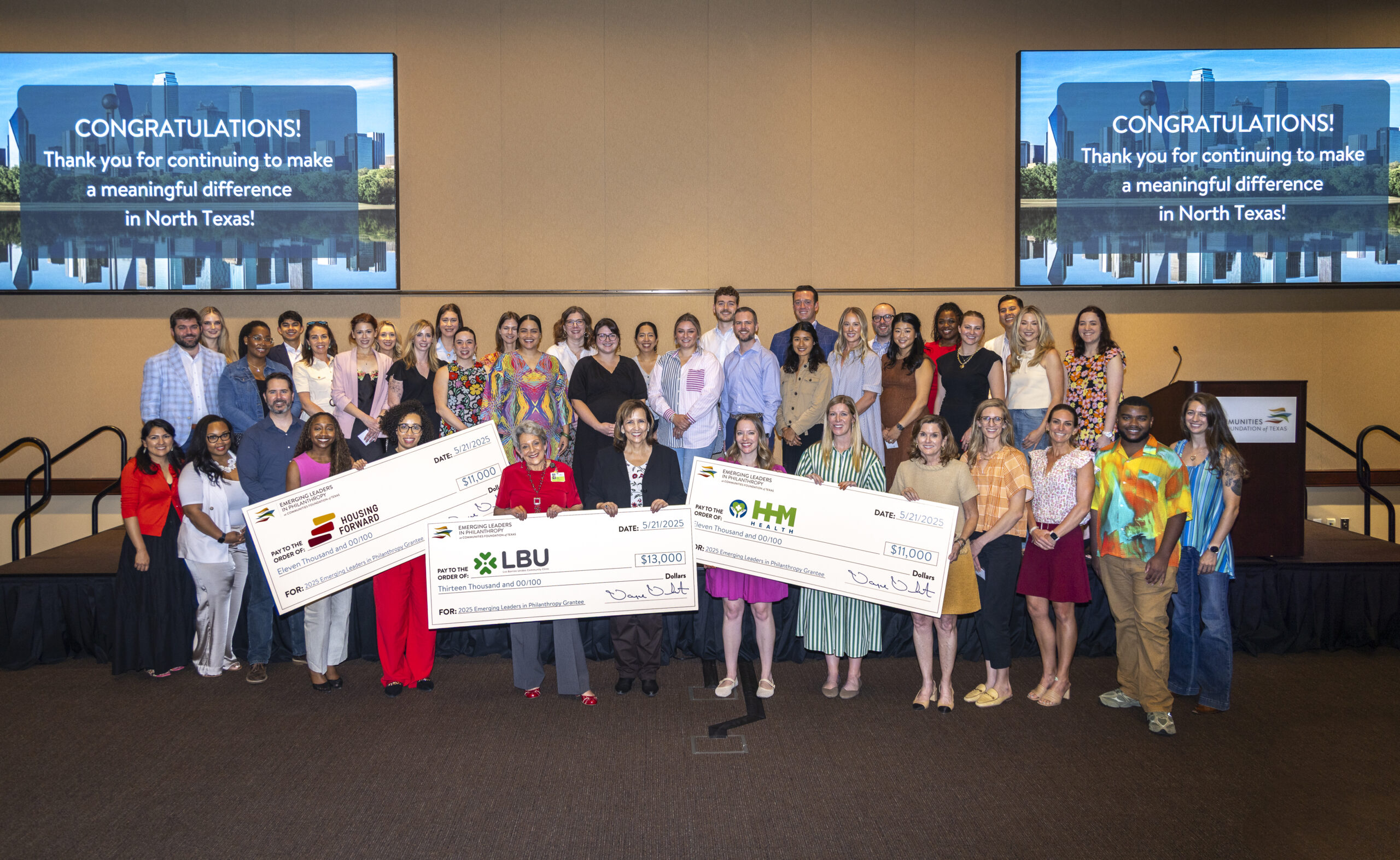
2025’s Emerging Leaders in Philanthropy celebrating nonprofit grantees, Housing Forward, LBU Community Clinic, and HHM Health.
The eight organizations that received 2025-26 grants from the Cotton Bowl Foundation were Uplift Education ($150,000), For Oak Cliff ($65,000), Academy 4 ($50,000), After-School All-Stars ($30,000), HOPE Farm ($25,000), West Dallas Community School ($25,000), Puede Network ($10,000) and Youth Revive ($10,000).
“Positively impacting our community through our grants program is at the essence of why we created the Cotton Bowl Foundation,” said W. Kelvin Walker, Chair, Cotton Bowl Foundation and Cotton Bowl Athletic Association. “We take a lot of pride in being able to support wonderful organizations like these that are truly making the lives of children and families better in their homes, neighborhoods and communities across North Texas.”
Uplift Education
The $150,000 grant given to Uplift Education helped make the Uplift Wisdom Campus football field project a reality. For the 2025-26 school year, Uplift Wisdom is fielding middle school and high school football teams for the first time.
“At Uplift Education, we’re committed to providing a free, high-quality education that prepares scholars for college, career and life,” said Dr. Remy Washington, Uplift Education President and incoming Chief Executive Officer. “Thanks to the incredible generosity of the Cotton Bowl Foundation, our new football field is creating meaningful opportunities for scholar-athletes to build teamwork, leadership and school pride. This investment not only enhances our athletic programs but also enriches the overall scholar experience – helping us develop well-rounded young leaders who excel both on the field and in the classroom.”
For Oak Cliff
The $65,000 grant awarded to For Oak Cliff is being used to support its youth-centric programming as a part of its culturally responsive initiatives focused on the South Oak Cliff neighborhood.
“We thank the Cotton Bowl Foundation so much for this gift in support of our youth services and programs designed to enhance our goals in the community and create a beacon of hope,” said Xavier Henderson, For Oak Cliff Chief Strategy Officer.
Academy 4
The $50,000 grant for Academy 4 is being used to enhance its fundamental mission to provide mentors for fourth-grade students in low-income schools across the North Texas community and around the state of Texas.
“The mission of Academy 4 is to change lives through relationships,” said John Shearer, Academy 4 Executive Director. “With the support of the Cotton Bowl Foundation, we can provide more mentors to encourage fourth graders to be leaders while making them feel known, cared for and loved.”
After-School All-Stars
After-School All-Stars is using its $30,000 grant to support its mentorship program and after-school programming as one of the country’s largest nonprofit organizations working to close the opportunity gap for low-income youth.
“Our programs ensure students receive what all youth need – being paired with a positive adult mentor, getting new experiences that spark a love of learning and being around a positive peer group,” said Justin Hensley, After-School All-Stars Executive Director. “These three elements impact the trajectory of kids’ lives and providing them in the after-school hours gives students something to look forward to at the end of every day.”
HOPE Farm
HOPE Farm was surprised with its $25,000 grant during the launch of North Texas Giving Day 2025. The surprise came on the Aug. 14 edition of WFAA-TV’s Midday newscast. Walker unveiled the surprise in an interview with HOPE Farm Executive Director/Board President Sacher Dawson and Communities Foundation of Texas President and Chief Executive Officer Wayne White.
“HOPE Farm transforms at-risk youth by our four-pillar approach – read, feed, parent and empower. We also have a mothers-resource program that’s what really sets us apart from other leadership development programs,” said Dawson. “We are so thankful to the Cotton Bowl Foundation for this generous donation.”
West Dallas Community School
The $25,000 grant provided to West Dallas Community School is going to upgrade hardware and software at the educational institution, celebrating 30 years during the 2025-26 academic year.
“West Dallas Community School has provided a transformational pre-K through eighth-grade education to low-income families for 30 years,” said Sam Turner, West Dallas Community School Head of School. “With the generous support of the Cotton Bowl Foundation, our underserved community will continue to have access to an excellent Christian education where students grow in mind, body, and spirit to reach their fullest potential. Together, we will shape future leaders and positively impact the families of West Dallas for generations to come.”
Puede Network
Puede Network is putting its $10,000 grant to work in support of its Puede Scholars program, which focuses on after-school programming that includes STEM projects, creative arts, fitness activities and hands-on learning for youth ages 3-15.
“On behalf of every scholar and family we serve, we extend our profound gratitude to the Cotton Bowl Foundation,” said Adan Gonzalez, Puede Network Executive Director. “This investment is an act of faith in the potential of South Dallas youth, ensuring that our students not only receive vital academic and athletic support but are empowered to write a new legacy – one defined by leadership, excellence and the relentless pursuit of a college education. This is how we build community change that lasts a lifetime.”
Youth Revive
The $10,000 grant awarded to Youth Revive is being used to expand its youth civic engagement programs as one aspect of the South Dallas organization’s continuing commitment to help close the gap for youth in low-income communities.
“There has never been a more pivotal moment to invest in the character and civic development of our youth,” said Adrian McConnell, Youth Revive Executive Director. “When young people embody civility and responsible citizenship, they have the power to reconnect, rebuild and revive their communities from within. Youth Revive exists for this very purpose to meet this defining moment with intention, action and hope.”
As a part of the Cotton Bowl Foundation’s philanthropic pursuits this year, the official foundation for the Goodyear Cotton Bowl Classic donated dollars beyond its grants initiative that will change lives for years to come in North Texas and across the country.
The Foundation extended a $25,000 grant, matching a $25,000 donation from American Airlines, to Tarrant Area Food Bank during the 2025 TAFB Thanksgiving Mega Mobile Market, awarded $250,000 in partnership with Amazon and the College Football Playoff Foundation to Catch Up & Read, City Year Dallas, Educate Texas and United to Learn and supported art teachers and programs in North Texas with $75,000 in grants, once again in partnership with Amazon and the CFP Foundation, through the Goodyear Cotton Bowl Classic Art Contest presented by Amazon.

About the Cotton Bowl Foundation
The Cotton Bowl Foundation, the official foundation of the Goodyear Cotton Bowl Classic, serves North Texas by supporting programs that improve opportunities for underserved youth with the vision of making an impact on those who play the game, attend the game and support the game. Since 2016, the Cotton Bowl Foundation has awarded more than $4 million in grants and financial support benefiting nonprofit organizations in the surrounding communities.
This year alone, the Cotton Bowl Foundation has awarded more than $465,000 in grants to deserving organizations striving to make a difference in communities across North Texas.
Follow the Goodyear Cotton Bowl Classic and Cotton Bowl Foundation on X/Twitter, Facebook, Instagram, YouTube, LinkedIn and TikTok.
Communities Foundation of Texas (CFT) announced a new 5-year, $50 million commitment to investing in neighborhoods and housing as part of its strategic priorities to build a thriving community.
“As part of CFT’s 5-year strategic plan, we’re taking on a new initiative to increase our investments in housing, in alignment with our focus on health, wealth, living, and learning. Housing is a central challenge impacting each of these focus areas, and if we can’t address our local housing crisis, we can’t effectively meet our community’s needs,” said Connie Blass O’Neill, CFT’s Board Chair. “We’re aligning our efforts around expanding housing access with the City of Dallas and other key partners. We know when we work together, we will see better outcomes,” said O’Neill.
Kimberly Bizor Tolbert, Dallas City Manager, spoke at the event, noting, “When we talk about attracting investment, growing our workforce, improving public safety, and building stronger families—it all comes back to this question: Can people afford to live in the city they serve, the city they love, and the city they call home? Right now, too many Dallas residents are being priced out or pushed out—locked out of ownership, stability, and opportunity. This isn’t just a housing crisis. It’s an economic, health, and opportunity challenge. That’s why housing affordability and production are top priorities for the City of Dallas.”
“Communities thrive when residents at every income level have secure housing, a strong education, a voice in their community, a sense of safety, and access to resources that improve their health and wellbeing. This is our North Star for building and growing sustainable communities,” said Nadine Dechausay, chief strategy and insights officer at CFT, who is spearheading CFT’s strategy.
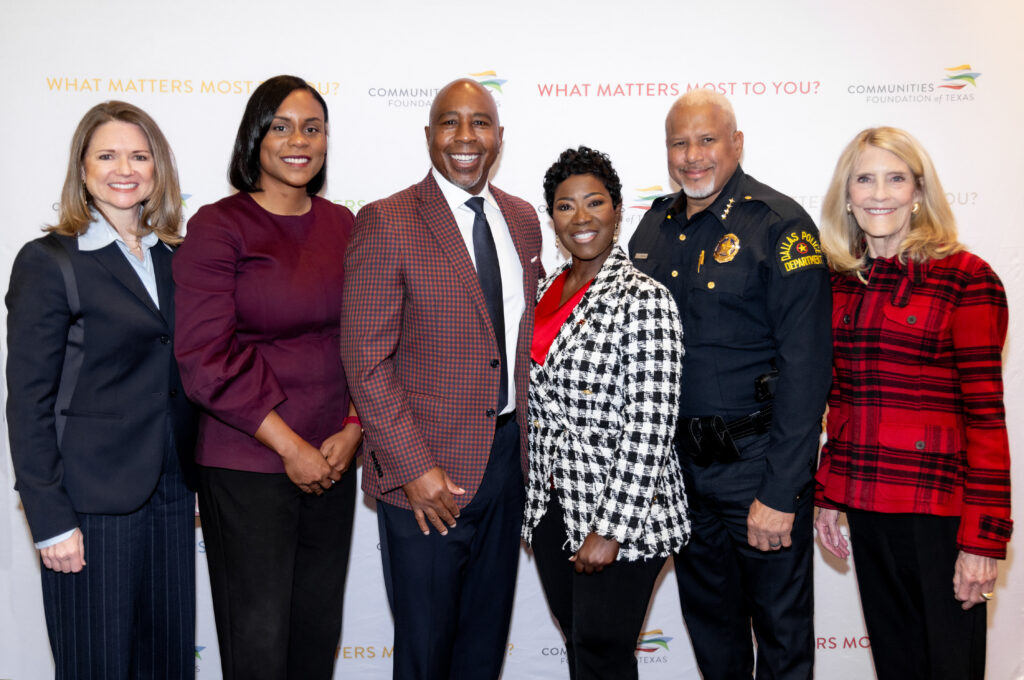
Pictured left to right: Debra Brennan Tagg, Chair, Housing Strategy Committee, CFT’s Board of Trustees; Nadine Dechausay, Chief Strategy & Insights Officer, CFT; Wayne White, President & CEO, CFT; Kimberly Bizor Tolbert, City Manager, City of Dallas; Daniel C. Comeaux, Chief of Police, Dallas Police Department; Connie Blass O’Neill, Chair, CFT’s Board of Trustees
One of the reasons that the prices of houses and apartments have outpaced incomes is because the region is not producing enough housing to meet demand. As a result, the average home in DFW costs more than four times the median household income and the region loses thousands of affordable rental units each year.
“We’re on a troubling trend. We didn’t build fast enough to keep up with North Texas’ rapid growth and the demand to live here,” said Cullum Clark, Director of the George W. Bush Institute-SMU Economic Growth Initiative. “We have a number of our residents living in, by modern standards, homes and units that aren’t fit for human habitation, and in other cases just not nearly as good as we might hope for in our city,” said Clark.
“We recognize that as the largest community foundation in Texas with a nearly 75-year history in North Texas, we have room to be bold. Our Board of Trustees have committed an extraordinary $50 million of CFT funds over the next five years to help address our city’s housing challenges. We believe, with the partnership of other foundations, fundholders, corporations, banks, policymakers, and community leaders, that we will match that investment, creating a $100 million Housing Impact Fund dedicated to lasting change,” said Wayne White, President and CEO at Communities Foundation of Texas.
“Our role as a community foundation will be threefold: to collaborate, to convene, and to co-invest. Through ‘patient capital’, we aim to strengthen the housing ecosystem—advancing policy, production, and preservation,” said White.
“We have organizations and initiatives working across multiple different segments of housing. What has been asked of CFT is to address the issue of fragmentation, to take the lead in coordinating and aligning efforts, building a bigger platform for community-driven impact,” said Dechausay.
CFT’s initial housing strategy centers around three pillars: partnership and policy, production, and preservation – a combination of strategies that has proven effective in other cities.
The “partnerships and policy” pillar centers around convening the public-private sector to collaborate and improve systems. Announced at the event, one of the first elements has been establishing HouseDTX, a new network of funders, advocates, planners, and community leaders that will elevate housing ecosystem work throughout the City.
Led by Nadine Dechausay of CFT, Cullum Clark of the Bush Institute, Ashley Brundage of Habitat for Humanity, Ashley Fores of Child Poverty Action Lab, Bryan Tony of the Dallas Housing Coalition, and Ruben Landa, Brian Keith, and Shane Phillips of the Greater Dallas Planning Council, HouseDTX will work to advance housing policy and practices. The alliance intends to release a housing scorecard next year that will track progress towards filling housing gaps and stabilizing housing stock.
The “preservation” pillar centers around ensuring that existing housing units can remain affordable, safe, and well-maintained. One of the first elements has been partnering with The Real Estate Council (TREC) and JP Morgan Chase to establish the Dallas Community Land Trust. The community land trust model has been helpful in many other regions, including in other areas in Texas.
“The Community Land Trust is a new form of ownership that allows access to more people. It opens that door and unlocks the dream of home ownership for more families,” said Stephanie Champion, Board Chair of the Dallas Community Land Trust.
Frazier Revitalization recently contributed the first two homes to the Dallas Community Land Trust.
The “production” pillar centers around increasing the supply of homes that are accessible to more people. This includes partnerships with mission-aligned community developers and builders, incubating innovative construction methods, and providing access to low-cost capital through new loan funds, including the use of program-related investments (PRIs). PRIs serve as recyclable philanthropic capital, expected to be paid back by a certain time, usually at a below-market interest rate.
CFT’s Housing Impact Fund was created to deliver low-cost, recyclable capital to the local housing sector, enabling developers to build more. “This Fund allows us to have an immediate impact on housing production, while learning alongside others. It allows us to work with and co-fund alongside partners who’ve already been making housing-related investments such as the Muse Foundation, Meadows Foundation, and Rees-Jones Foundation,” said Dechausay.
Communities Foundation of Texas has committed $50 million over the next five years as part of this new strategic initiative, and in the past several months, has granted more than $4 million in aligned grant funding:
Community Investments:
- Dallas Economic Development Corporation: $1.5 million grant for operating support over three years
- Downtown Dallas, Inc.: $1.5 million over two years for implementation of the Safe in the City initiative
Partnerships & Policy:
- Greater Dallas Planning Council: $50,000 grant to build consensus-based housing recommendations
- Dallas Housing Coalition: $25,000 grant for operating support
Production:
- Dallas Housing Opportunity Fund – $500,000 grant to Local Initiatives Support Corporation (LISC) for a recyclable capital grant that will produce units of rental housing. In response to the DFW’s severe housing shortage, LISC, one of the nation’s largest Community Development Finance Institutions (CDFI), was invited to come to Dallas to provide access to capital to build affordable homes and has been partnering with The Real Estate Council (TREC) since 2021. Through this partnership, 249 units have been created and are occupied, and another 424 units have received financing. The fund managers expect to have a total of 2,944 units constructed in the city of Dallas by 2028.
- buildingcommunityWORKSHOP – $250,000 grant to support the DreamBuild housing system startup, which utilizes modular construction to reduce costs and build homes faster and more efficiently.
- Texas Education Opportunity Fund (TEOF) – $200,000 program-related investment (PRI) loan to the LoMaX to help build units of housing using innovative shipping container construction methods on S. Malcolm X Boulevard across from The Stewpot. LoMaX, a 21-unit residential project currently under construction, is the first of its kind in Texas to re-purpose shipping containers using off-site fabrication combined with conventional financing and social impact investment.
- Additionally, CFT has created a $5 million PRI loan and grant fund led by CFT’s Housing Strategy committee that will allow for early investments while CFT is fundraising for the much larger investment fund it has created.
Preservation:
- Dallas Community Land Trust – $10,000 grant to enable Frazier Revitalization to contribute the first two homes to the Trust.
“Our goal is to support development that leads to economic mobility and shared prosperity. We understand that it will take more than five years to achieve our goals. This is the beginning of a long-term effort to address a challenge that impacts our neighbors, our future economic growth, and our City as a whole,” said White.
Read about this in the media:
Dallas Innovates: Communities Foundation of Texas Launches $50M Initiative to Tackle Dallas’ Housing Crisis
D CEO Magazine: A $100 Million Bet on Affordable Housing in Dallas
D Magazine – FrontBurner: Could a $100M Fund Help Relieve Dallas’ Affordable Housing Problem?
Dallas Morning News: Communities Foundation of Texas launches $50 million housing initiative
Dallas Business Journal: Communities Foundation of Texas launches $50M housing initiative to tackle affordability issues
NBC 5 DFW: Communities Foundation of Texas Launches $50M Dallas Housing Initiative
NBC 5 DFW: Millions pledged to grow Dallas housing
The Lab Report Dallas: These Stories Will Shape Dallas in 2026 – The True Housing Challenge: Protecting What We Have
WFAA: Communities Foundation of Texas aims to make housing more accessible in North Texas
White Rock Lake Weekly: Funds to address city’s housing challenges